

In short: Gojek and Tokopedia merged as one ecosystem. A year later, one customer in five used both. Nine-tenths of the goodwill was gone within three years.
Two famous names do not add up to one customer.
Jakarta, 17 May 2021. Andre Soelistyo, chief executive of the new GoTo Group, called it “a truly historic day.” Gojek, the ride-hailing, delivery and payments app, and Tokopedia, the online marketplace, were joining in “the largest ever business combination in Indonesia” (GoTo release, 17 May 2021).
Patrick Cao, GoTo’s president, gave the logic in one line: “Gojek’s high volume, high frequency mobility transactions, combined with Tokopedia’s high value, medium frequency e-commerce transactions.” A rider would become a shopper, and a shopper a rider.
What the room recognised
Everyone on the release had something to win. William Tanuwijaya, Tokopedia’s co-founder, called the new group proof “that you can believe in an ‘Indonesian dream’ and make it a reality.” Kevin Aluwi, Gojek’s co-founder, said they were “now in the unique position to meet all of a consumer’s daily needs.” Their backers agreed. Shailendra Singh of Sequoia Capital said he knew of no internet company anywhere “that has such deep ownership of so many categories at the same time” (same release).
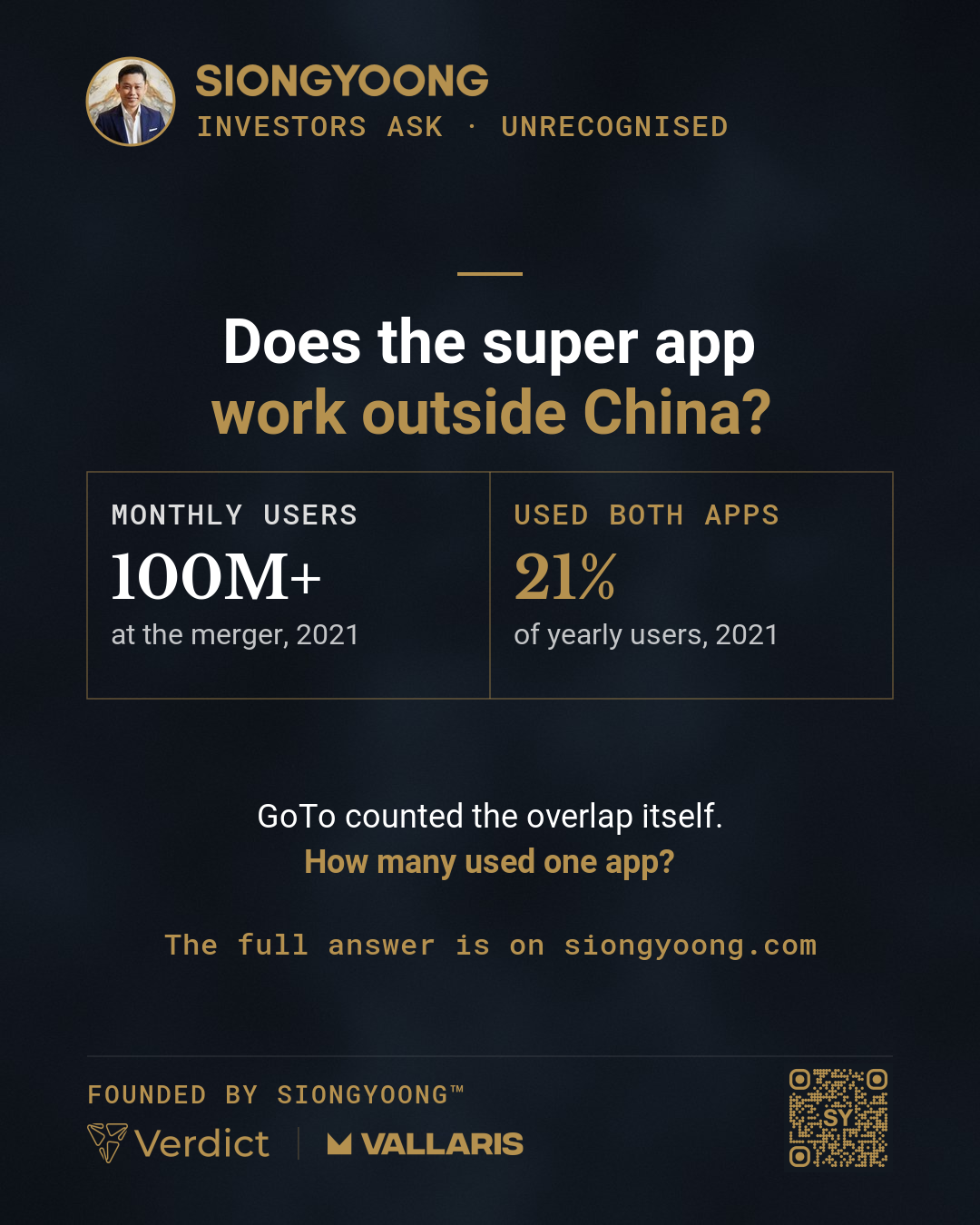
The release counted over 100 million monthly active users and over USD 22 billion of gross transaction value in 2020. It called the result “a globally unique and highly complementary ecosystem.” The two best-known names in Indonesian technology had become one, and the sum was on the first slide.
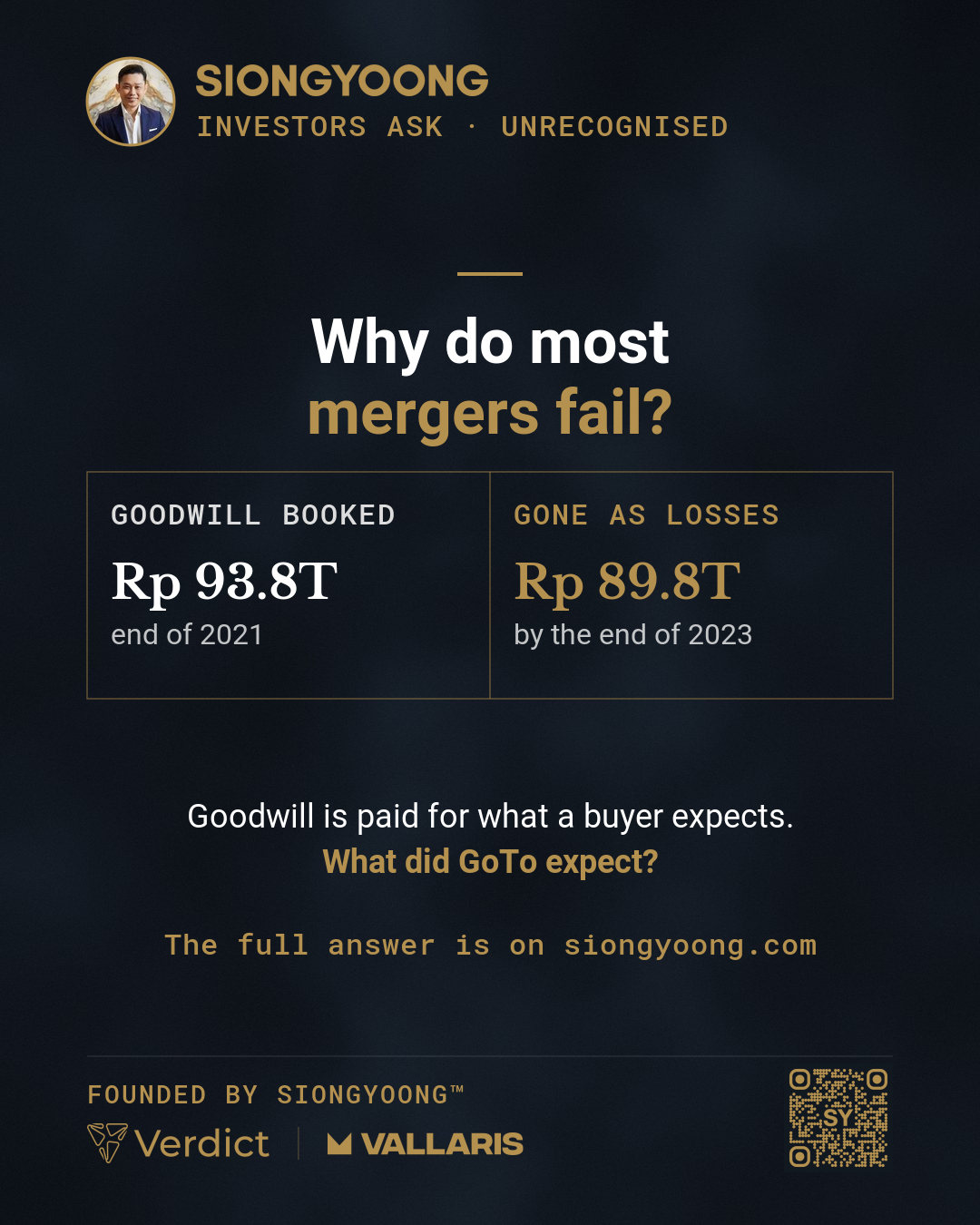
The price carried that logic. GoTo accounted for the merger as a purchase of Tokopedia paid in shares, and recognised Rp 93.1 trillion of goodwill on it, taking its goodwill to Rp 93.8 trillion at the end of 2021 (GoTo interim financial statements to 30 September 2022, note 33a; audited financial statements for 2022). Goodwill is paid for what a buyer expects.
Pause the story. Goodwill is the part of a price paid above everything the buyer can count on the day it pays: the cash, the code, the contracts. Picture two shops under one awning, priced as if every taxi passenger will step next door and collect a parcel. If the passengers walk past, the expectation is gone, and the books write the goodwill down.
What the evidence showed
31 May 2022. Now the number. GoTo counted the overlap itself. In 2021, 11.6 million people transacted on both Gojek and Tokopedia, 37% more than a year before, and “this overlap represents 21% of Gojek and Tokopedia ATUs,” its annual transacting users (GoTo FY2021 results release, 31 May 2022). Four in five customers used one app.
31 December 2022. GoTo recorded Rp 11 trillion of goodwill impairment for the year, almost all of it against its e-commerce business (GoTo audited financial statements for 2022, note 33a).
11 December 2023. TikTok agreed to take 75.01% of Tokopedia (The Jakarta Post, 11 December 2023), two months after Indonesia banned shopping inside social media apps (Reuters, 11 December 2023). The buyer was not a ride-hailing app. It was a video app that needed a licensed marketplace to reopen its shop in Indonesia.
19 March 2024. GoTo reported “a Rp 78.8 trillion goodwill reversal as required by prevailing accounting standards,” brought about by “the Tokopedia and TikTok transaction that resulted in loss of control of Tokopedia” (GoTo results release, 19 March 2024).
Together that is Rp 89.8 trillion of the Rp 93.8 trillion, more than nine-tenths, gone from the balance sheet as losses within three years of the merger (my sum of the two reported figures).
The case for the merger deserves its full weight. An overlap of 21% is not a failure. It grew 37% in a year, and GoTo published it rather than leave it out. A fact like that can be priced. What did not hold was pricing the other four in five as if they would follow.
Most mergers fail on the same line: the buyer pays today for customers who are expected to cross over tomorrow.
The pitch added the customers. The evidence counted them.
What to do this week
The same slide turns up in smaller deals: two portfolio companies that should merge, or a founder who plans to sell into a partner’s users. The sum on it is true, which is why it persuades an investment committee. The overlap is the number your price will rest on, whether anyone asks for it or not.
Tuesday, in the next pitch that adds two customer bases together, stop on that slide and ask one question: what share of customers already pay for both, and how did that share move over the last 12 months? Watch the meeting change. The founder stops defending a total and starts showing a behaviour. GoTo’s balance sheet carried that question for three years and Rp 89.8 trillion. A deck can answer it in one table.
That is the read Verdict™ automates: the deck’s own numbers, scored against your mandate, before a famous name can tilt it.
Two famous names do not add up to one customer. Price the customers who already walk into both shops, not the awning over them.
This article was written on public information available on 27 October 2026. Later events may change the picture, and this page will not be updated for them. It is general commentary for information only. It does not take into account your objectives, financial situation or needs, and it is not investment advice or a recommendation to buy, sell or hold any security. Please seek your own advice from a licensed adviser before acting. See the full disclaimer.
The questions this issue answers.
Does the super app work outside China?
Where it is asked: Ask HN: Where Are the Super-Apps? (Hacker News, 9 January 2024); I just don’t understand the appeal of “Super Apps”. Do users really want to hire a taxi with the same application they use to message their friends? (Hacker News, 21 March 2024).
The answer that went viral: Jeff Jensen, CNBC, “Why U.S. Tech Companies Struggle To Replicate China’s WeChat ‘Super App’ Model” (YouTube, 21 January 2025; 451,760 views and 6,337 likes on YouTube). Super apps grew in Asia on convenience and the way people already used their phones; in the US, rules on lending, data privacy and competition make one app for everything harder to build. Read it
What the evidence showed: Four in five customers used one app.
Why do most mergers fail?
Where it is asked: If most acquisitions fail, then why do companies make them? (Quora); New book asks why ever more is spent on mergers when so many fail (Cambridge Judge Business School, 13 July 2022).
A public answer: Clayton M. Christensen, Richard Alton, Curtis Rising and Andrew Waldeck, Harvard Business School and Innosight, “The New M&A Playbook” (Harvard Business Review, March 2011). Most deals fail because the buyer overrates what it gains by absorbing the target and pays too much for it. Read it
What the evidence showed: Most mergers fail on the same line: the buyer pays today for customers who are expected to cross over tomorrow.
Sources
- GoTo, “Gojek and Tokopedia combine to form GoTo, the largest technology group in Indonesia and the ‘go to’ ecosystem for daily life”, 17 May 2021. Key figure: Monthly active users at the merger: Over 100 million.
- GoTo, FY2021 results release (“GoTo Group report”), 31 May 2022. Key figure: Customers who used both Gojek and Tokopedia, 2021: 11.6 million, 21% of annual transacting users.
- PT GoTo Gojek Tokopedia Tbk, consolidated financial statements for the year ended 31 December 2022 (audited), note 33a, as filed. Key figures: Goodwill at 31 December 2021: Rp 93.8 trillion; Goodwill impairment, 2022 (almost all e-commerce): Rp 11 trillion.
- The Jakarta Post, “TikTok marks e-commerce return with $1.5 billion deal to acquire Tokopedia”, 11 December 2023. Key figure: Stake in Tokopedia taken by TikTok: 75.01%.
- Reuters, “TikTok to invest $1.5 billion in Indonesia’s GoTo”, 11 December 2023 (as published by The Star).
- GoTo, “GoTo Group Turns Adjusted EBITDA Positive, Surpassing Full Year Guidance as Company Reports 2023 Fourth Quarter and Full Year Results”, 19 March 2024. Key figure: Goodwill reversal, 2023, on loss of control of Tokopedia: Rp 78.8 trillion.
- PT GoTo Gojek Tokopedia Tbk, interim consolidated financial statements to 30 September 2022 (unaudited), note 33a, business combinations, page 5/140 (Tokopedia: total purchase consideration Rp 113,205,360 million; goodwill Rp 93,106,582 million). Key figure: Goodwill recognised on Tokopedia: Rp 93.1 trillion.
Drawn from the public filings and reports below. A reading of one deal, not advice on any company or its shares.