

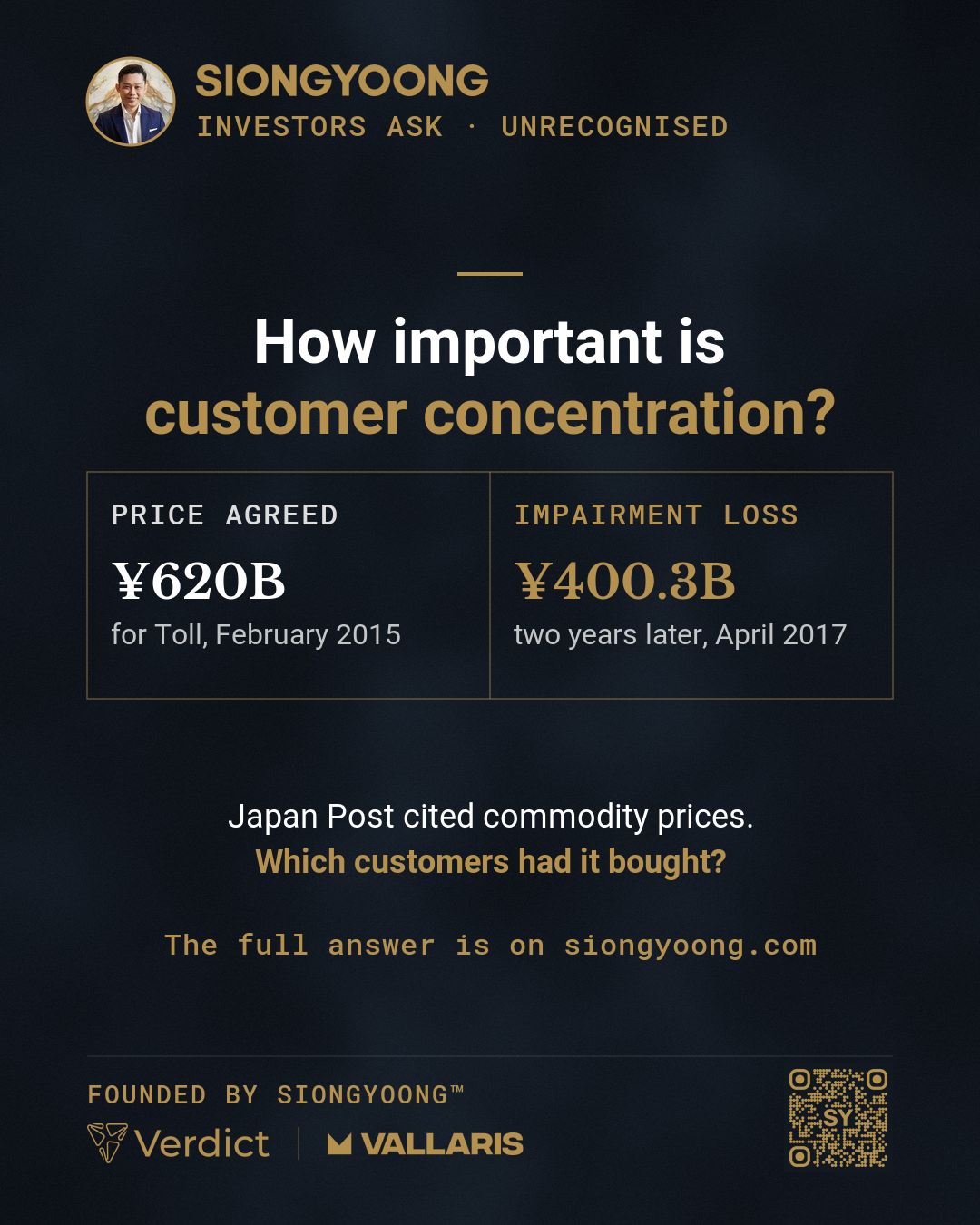
In short: Japan Post paid about ¥620 billion for Toll, Australia’s leading listed logistics company, in 2015. Two years later it recognised an impairment loss of ¥400.3 billion and gave its reason: a sharp fall in commodity prices.
What a company does is not what it earns from.
Tokyo, February 2015. Under Taizo Nishimuro, its president, Japan Post was preparing to list its shares. Reuters later described the deal as “the crucible in which Japan Post would transform itself into a global logistics powerhouse” (Reuters, 3 May 2017).
On 18 February 2015 Japan Post announced it would buy Toll Holdings, “the leading listed Australian logistics company”, for A$9.04 a share, about ¥620 billion in all (Japan Post notice, 18 February 2015). Toll’s chairman, Ray Horsburgh, told the market: “Together this will be a very powerful combination and one of the world’s top five logistics companies” (Reuters, via CNBC, 17 February 2015).
What the room recognised
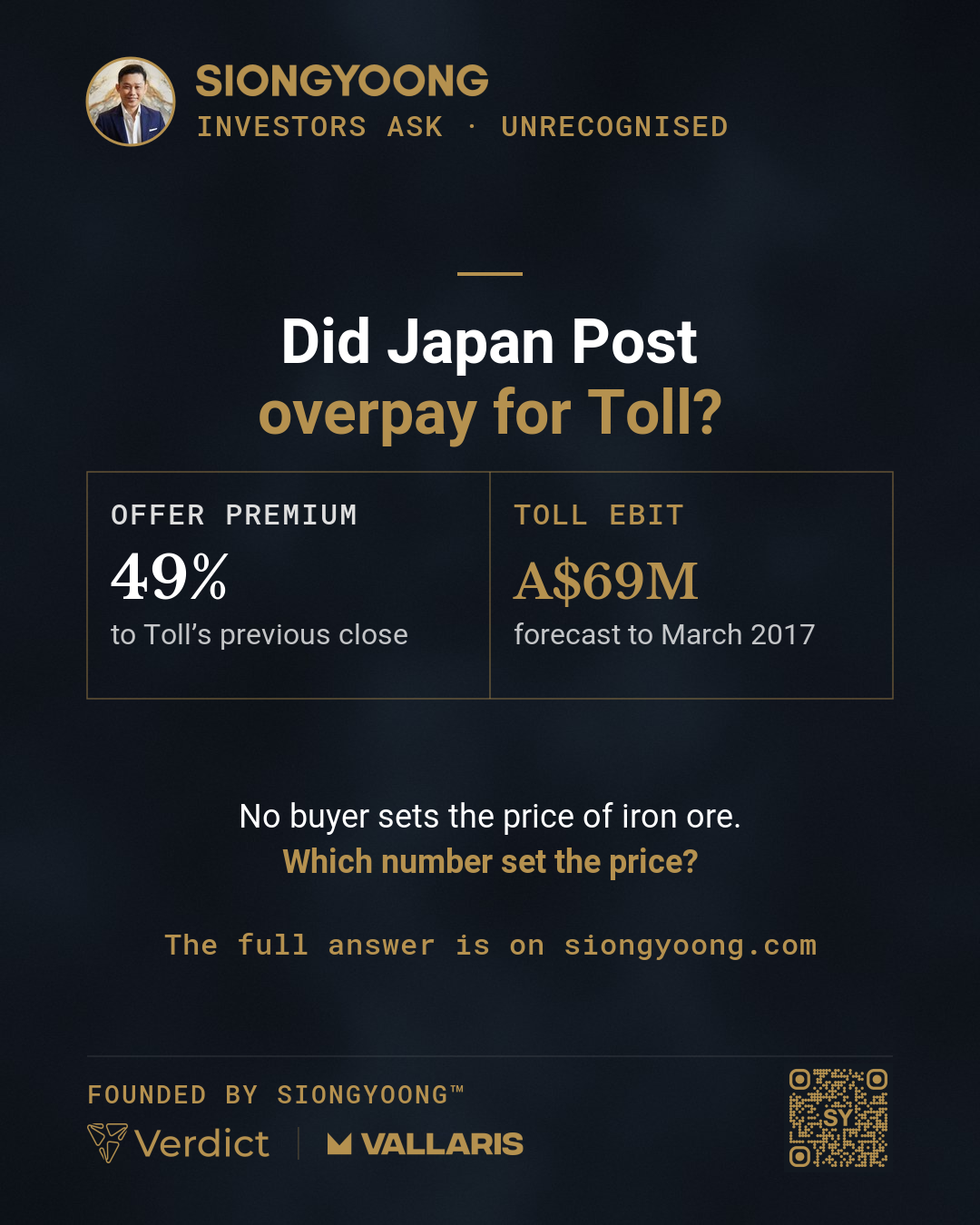
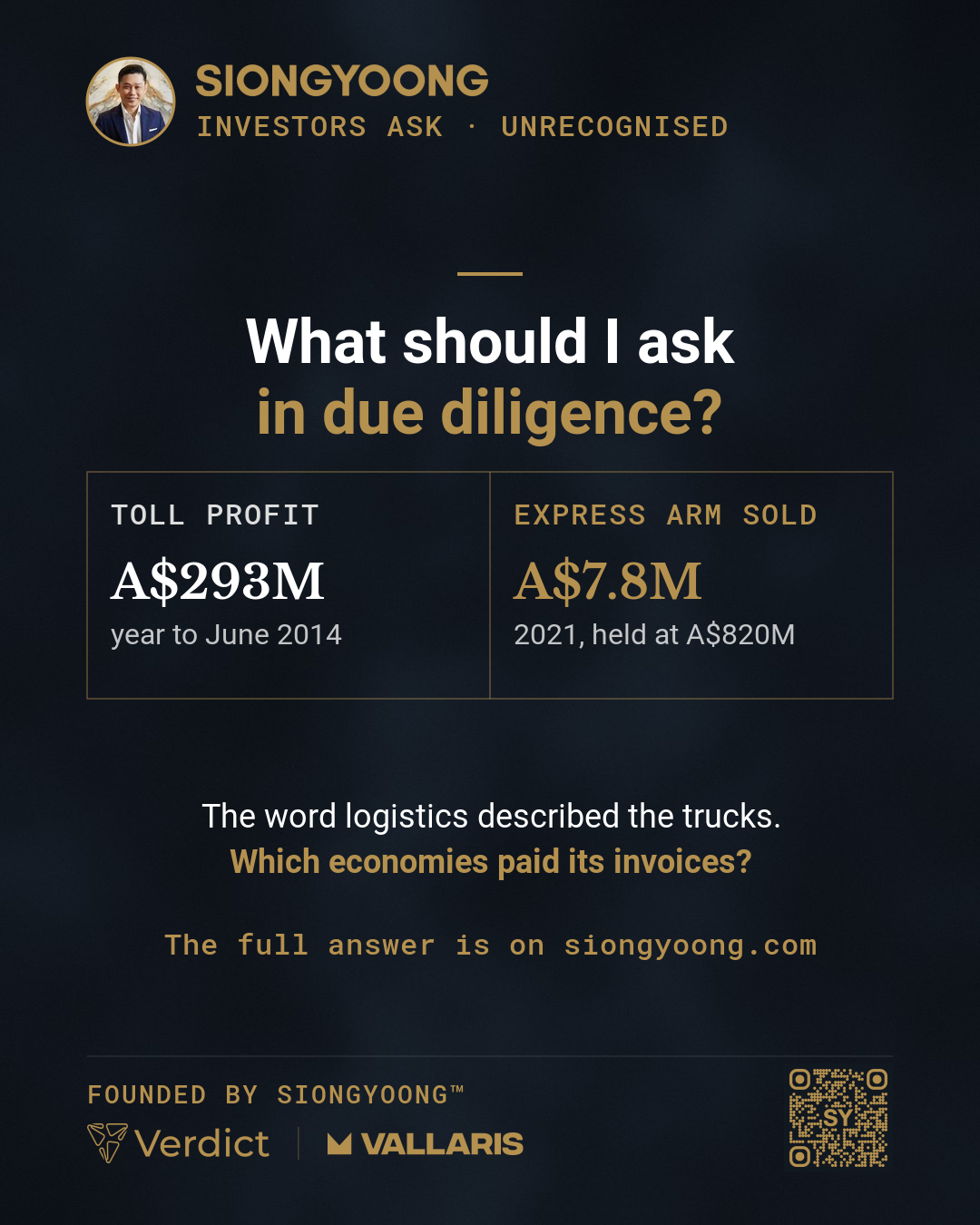
Everyone at the table could picture the business. Japan Post moved letters and parcels across Japan. Toll moved freight across Australia and Asia, with “particular strengths in forwarding, third-party logistics, and express services”, and had made a profit of A$293 million on revenue of A$8,811 million in the year to June 2014 (Japan Post notice, 18 February 2015). Japan Post said it would use the deal “to grow as a comprehensive international logistics company” (same notice). Toll’s shareholders were offered a 49% premium to the previous day’s close, and its directors called the valuation compelling (Reuters, via CNBC, 17 February 2015).
One delivery company buying another reads as a fit. The same day, Toll reported a 22% fall in half-year net profit, and Reuters noted that its expansion into Asia had left it exposed to falling commodity prices and freight volumes (Reuters, via CNBC, 17 February 2015).
Pause the story. A freight company is paid by the people whose goods it carries, so its customer list is a map of the economies it rides on. Two companies can run the same trucks and live on different customers: one on households sending parcels, the other on mines and steelworks moving ore and machinery. From the depot they look alike. The invoices go to different places.
What the evidence showed
June 2014. Toll’s earnings before interest and tax (EBIT) for the year: A$444 million (Japan Post notice, 25 April 2017).
25 April 2017. Japan Post expected Toll’s EBIT for the year to March 2017 at A$69 million. It recognised an impairment loss of ¥400.3 billion, ¥392.3 billion of it “for all balance of goodwill and trademark rights”, and gave its reason: “a sharp fall in commodity prices and a slowdown in the Australian and Chinese economy” (Japan Post notice, 25 April 2017). Its forecast for the year moved from a net profit of ¥320 billion to a net loss of ¥40 billion (same notice).
3 May 2017. Reuters reported that a sharp slowdown in Australia’s mining and steelmaking industries had cut freight demand. “Commodity prices fell faster than we had thought, and we couldn’t imagine the direct impact on Toll’s earnings,” Hideo Murata, a Japan Post spokesman, told Reuters (Reuters, 3 May 2017).
21 April 2021. Japan Post agreed to sell Toll’s express business in Australia and New Zealand to affiliates of Allegro Funds, a Sydney private equity firm, for net proceeds of about A$7.8 million. The business stood in its accounts at A$820 million (Japan Post notice, 21 April 2021).
The case for the deal deserves its full weight. Japan Post was looking beyond a home market where the population has been shrinking (Reuters, via CNBC, 17 February 2015). Toll was profitable and led its market when it was bought. Japan Post said its due diligence took in “the opinion of accounting, taxation, legal and financial experts” (Reuters, 3 May 2017). No buyer sets the price of iron ore.
Japan Post cited commodity prices. A postal group had learned, at a cost of ¥400.3 billion, which customers it had bought. The word logistics described the trucks. The customer list described the earnings, and Reuters had named the exposure on the day of the offer.
The room bought what Toll did. The evidence priced what Toll earned from.
What to do this week
The same company turns up in your pipeline: a distributor, a contract manufacturer, a staffing firm in the sector you know best. You recognise the work, so the work starts to feel like evidence, yet recognising the work tells you nothing about who pays for it. Your price rests on whoever pays the invoices, and on whatever moves their budgets. Read this way, a company shows you, before the cheque, which downturn your price is exposed to.
When I read a company for a buyer, the table I ask for before the strategy slides is revenue by customer, grouped by the customer’s own industry. This week, before your next meeting on a company in a sector you know, ask for that table for the last three years, and count how many economies sit behind the top ten names. If one shock reaches most of them, price that shock first. Concentration can sit in an industry as well as in a name.
What a company does is not what it earns from. Open the last deck you passed on and look for that table.
This article was written on public information available on 9 November 2026. Later events may change the picture, and this page will not be updated for them. It is general commentary for information only. It does not take into account your objectives, financial situation or needs, and it is not investment advice or a recommendation to buy, sell or hold any security. Please seek your own advice from a licensed adviser before acting. See the full disclaimer.
The questions this issue answers.
How important is customer concentration?
Where it is asked: Is it ever okay to buy a business with high customer concentration? (a searcher; also asked there as “How important is customer concentration?”) (Searchfunder, about 2022 (shown as 4 years ago on 8 November 2026)); Is Customer Concentration a Deal Killer? (Atlasview Insights, 4 January 2023).
A public answer: A Searchfunder member, professional, Southern Methodist University, “When Ten Customers Are Really Just One” (Searchfunder, about March 2026 (shown as 8 months ago on 8 November 2026)). A customer list can look spread out and still ride one shock, through a shared industry, region, owner or distributor, so measure that shared exposure rather than the top name alone. Read it
What the evidence showed: Concentration can sit in an industry as well as in a name.
Did Japan Post overpay for Toll?
Where it is asked: Is Japan Post overpaying for Toll? (CNBC (Leslie Shaffer), 18 February 2015); Ex Toll boss Paul Little the winner as Japan Post says it overpaid by $4.8b (The Sydney Morning Herald, 26 April 2017).
A public answer: Anthony Moulder, transportation analyst, Citigroup, “Is Japan Post overpaying for Toll?” (CNBC, 18 February 2015). The offer, with its control premium, was well above fair value for Toll and its prospects, so shareholders should take it; the same report noted Toll’s resources customers were being hit by weak commodity prices. Read it
What the evidence showed: The evidence priced what Toll earned from.
What should I ask in due diligence?
Where it is asked: Buying a small business. What questions should I ask during due diligence? (Reddit, r/smallbusiness, May 2023); Reddit Q&A: Buying a small business, what questions should I ask during due diligence? (Clearly Acquired (Samson Jagoras), 1 July 2025).
A public answer: Mark Meloche, Director, Growth & Transition Capital, BDC, “How to conduct due diligence when buying a business” (BDC.ca, updated 24 November 2025). Find out who the customers are and whether a few make up a large share of sales; where they do, meet those customers and ask whether their buying will change. Read it
What the evidence showed: When I read a company for a buyer, the table I ask for before the strategy slides is revenue by customer, grouped by the customer’s own industry.
Sources
- Japan Post Holdings, “Notice: Japan Post Announces Intention to Acquire Australian Logistics Company Toll”, 18 February 2015. Key figure: Price agreed for Toll: About ¥620 billion (A$9.04 a share).
- Reuters, “Australia’s Toll Holdings agrees to $5.1 billion takeover by Japan Post”, published by CNBC, 17 February 2015. Key figure: Premium to Toll’s previous close: 49%.
- Japan Post Holdings, “Recognition of Impairment Loss, Revision of the Consolidated Financial Results Forecast for the Fiscal Year Ended March 31, 2017 and Recognition of Loss on Valuation of Stocks of Subsidiaries”, 25 April 2017. Key figures: Toll EBIT, year to June 2014: A$444 million; Toll EBIT expected, year to March 2017: A$69 million; Impairment loss, April 2017: ¥400.3 billion.
- Thomas Wilson and Byron Kaye, Reuters, “Taking a Toll: How Japan Post’s big global bet unravelled”, 3 May 2017, published by Business Standard.
- Japan Post Holdings, “Notice Concerning Partial Business Transfer of Subsidiary Company”, 21 April 2021. Key figure: Net proceeds from sale of Toll’s express business, 2021: About A$7.8 million (book value A$820 million).
Drawn from the public filings and reports below. A reading of one deal, not advice on any company or its shares.