

In short: Quibi showed investors a downside, a base and an upside case. All three assumed people would pay to watch ten-minute shows on a phone. Raised: USD 1.75 billion. Subscriber households by the third quarter of 2020: about 710,000 (Kantar estimate).
Three forecasts can share one assumption.
Los Angeles, December 2018. Jeffrey Katzenberg, founder and chairman of a company called Quibi, and Meg Whitman, its chief executive and before that the chief executive of eBay and Hewlett Packard Enterprise, were raising money for a new kind of streaming service: premium shows, ten minutes or less, made only for the phone.
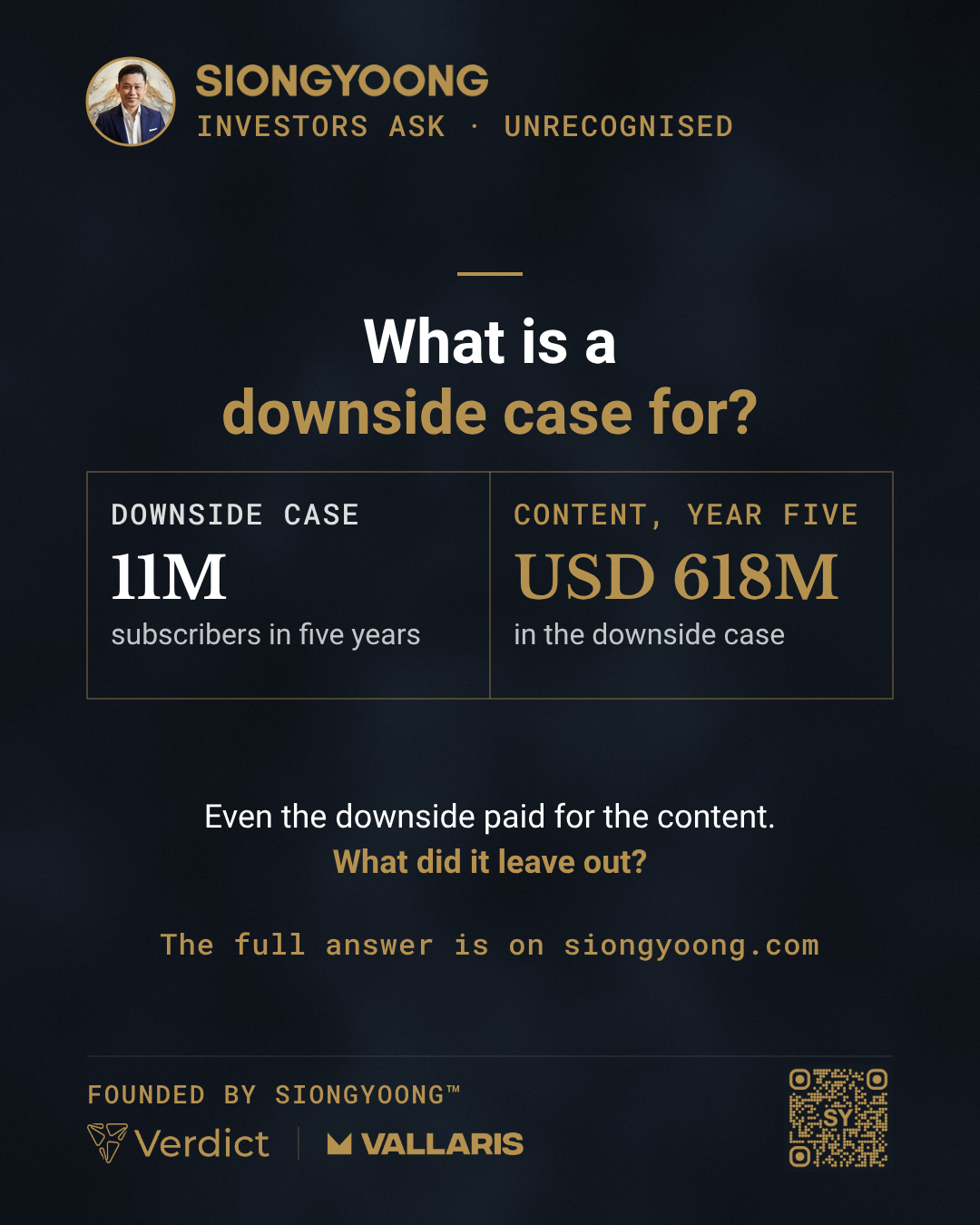
The pitch deck gave investors three cases for five years out (Digiday, 10 December 2018). The downside: 11 million subscribers. The base: 20 million. The upside: 70 million. Subscribers would pay USD 5 a month with advertising, or USD 8 without.
What the room recognised
Everyone in the room had something to win. Katzenberg wanted a new category of entertainment. The studios that backed him, among them Disney, WarnerMedia, Sony, NBCUniversal and ViacomCBS (Variety, 15 June 2020), wanted a buyer for short premium shows. Advertisers wanted young viewers on their phones: Quibi said it had sold out its USD 150 million of advertising for the first year (Los Angeles Times, 4 March 2020).
On 4 March 2020 Quibi closed a second round of USD 750 million, taking the total raised to USD 1.75 billion. “We have strong content and an app design and user interface which is resonating with early users,” Whitman said (same report).
The deck gave the room a range to argue about, and a range feels careful. Even the downside paid for the content: it grew the content budget from USD 356.8 million in the first year to USD 618 million in the fifth (Digiday, 10 December 2018). The base case started at USD 600 million.
Pause the story. A forecast is a chain of assumptions multiplied together: how many people hear of the product, how many try it, how many pay, and how many stay. Most decks build their three cases by turning one dial, how many. Picture three lift buttons in one lobby, for the low, middle and top floors. All three need the building to stand. Every case in the deck assumed one thing: that enough people would pay to watch ten-minute shows on a phone.
What the evidence showed
6 April 2020. Quibi launched at USD 4.99 a month with advertising and USD 7.99 without (Los Angeles Times, 4 March 2020).
28 May 2020. The app had been downloaded about 4 million times since launch, by Apptopia’s count (Variety, 15 June 2020).
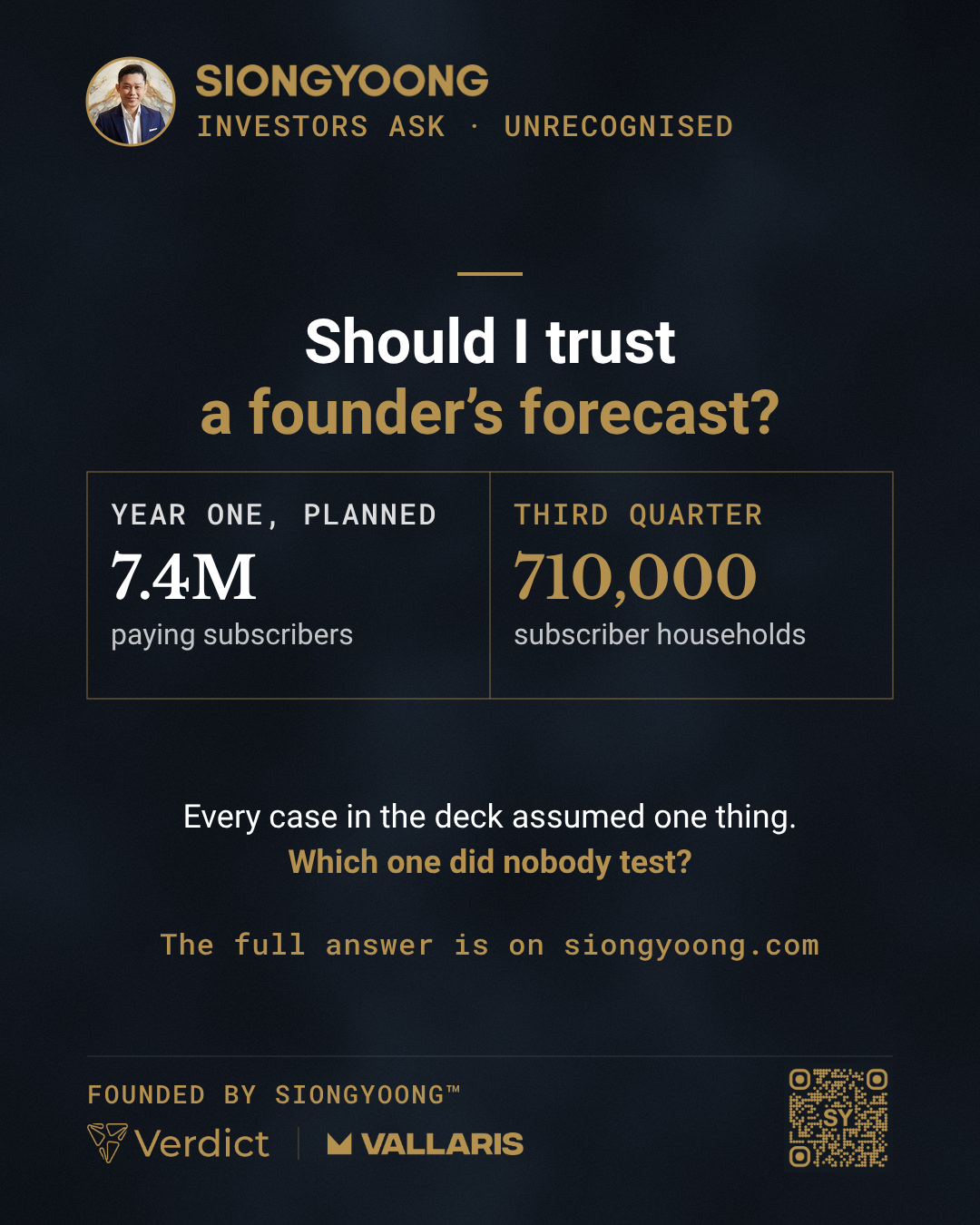
15 June 2020. The Wall Street Journal reported, from a source it did not name, that Quibi had projected 7.4 million paying subscribers after one year, and was on pace for fewer than 2 million by April 2021. A Quibi representative called the numbers “inaccurate” and did not elaborate (Variety, 15 June 2020).
30 September 2020. By the end of the third quarter, Quibi had about 710,000 subscriber households, Kantar estimated (Variety, 21 October 2020).
21 October 2020. The founders wrote to their employees, investors and partners that they were winding the business down and returning cash to shareholders. They gave two likely reasons: “because the idea itself wasn’t strong enough to justify a standalone streaming service or because of our timing” (Quibi, open letter, 21 October 2020).
8 January 2021. Roku bought the rights to more than 75 Quibi shows for what a source called “significantly” less than USD 100 million (Variety, 8 January 2021).
The case for the deck deserves its full weight. Its chief executive had run eBay and Hewlett Packard Enterprise. Advertisers committed before launch. And Quibi launched into a pandemic, a timing its founders could not have planned for and named themselves in their letter. Three cases is good practice.
What the three cases could not show was the one line they shared. The downside case was a smaller version of the same belief. Nobody in the room had a number from people paying for ten-minute shows on a phone, because nobody had sold them yet.
The deck gave the room three numbers to argue about. The evidence argued with the line under all three.
What to do this week
The same deck turns up in smaller rooms: a base case, an upside and a downside that is the base with a lower number. The range is honest, which is why it persuades an investment committee. The question it hides is the one your price rests on.
Tuesday, in the next pitch with three cases, stop on the forecast slide and ask one question: which assumption do all three cases share, and what have paying customers already done that supports it? Watch the meeting change. The founder stops defending a range and starts showing a behaviour. Quibi’s investors carried that question for two years and USD 1.75 billion. A deck can answer it in one line.
That is the read Verdict™ automates: the deck’s own assumptions, scored against your mandate, before a famous name can tilt it.
Three forecasts can share one assumption. Find it before you price the range.
This article was written on public information available on 2 November 2026. Later events may change the picture, and this page will not be updated for them. It is general commentary for information only. It does not take into account your objectives, financial situation or needs, and it is not investment advice or a recommendation to buy, sell or hold any security. Please seek your own advice from a licensed adviser before acting. See the full disclaimer.
The questions this issue answers.
Should I trust a founder’s forecast?
Where it is asked: Ask HN: How to write a convincing financial projection with little evidence? (Hacker News, 20 October 2021); Ask HN: Early angel/seed investors asking for detailed financial projections? (Hacker News, 10 November 2010).
The answer that went viral: Jeffrey Katzenberg and Meg Whitman, Quibi founder and chief executive, on CNBC, “Quibi CEO: Shutting down operations was most honorable choice for shareholders” (YouTube, 22 October 2020; 10,880 views and 83 likes on YouTube, as of 1 November 2026). The founders said the product market fit was wrong: they asked people to pay before people understood it, and a service built for people on the go launched when nobody was. Read it
What the evidence showed: What the three cases could not show was the one line they shared.
What is a downside case for?
Where it is asked: How to Build a Worst-Case Scenario Using a SaaS Financial Model (Hacker News, 8 April 2020); Model the worst-case financial scenario for your SaaS (Hacker News, 9 April 2020).
The answer that went viral: MacKenzie Sigalos, CNBC, “Why Quibi Shut Down After Only Six Months: CNBC After Hours” (YouTube, 22 October 2020; 86,391 views and 1,489 likes on YouTube, as of 1 November 2026). Quibi was built for viewing on the go, and it launched when stay-at-home orders meant almost nobody was on the go. Read it
What the evidence showed: The downside case was a smaller version of the same belief.
Sources
- Digiday, “Inside Jeffrey Katzenberg’s plan to spend up to $1b by 2025 on programming for Quibi”, 10 December 2018. Key figures: Subscribers in five years, three cases: 11 million, 20 million, 70 million; Content budget, first year, downside case: USD 356.8 million.
- Los Angeles Times, “Quibi touts $750-million haul in second fundraising round”, 4 March 2020. Key figure: Total raised: USD 1.75 billion.
- Variety, “Quibi on Pace to Hit Less Than 30% of Year-One Paid Subscriber Goal (Report)”, 15 June 2020, reporting the Wall Street Journal. Key figure: Paying subscribers projected after one year: 7.4 million.
- Variety, “Quibi Confirms It’s Shutting Down: ‘The World Has Changed Dramatically,’ Jeffrey Katzenberg Says”, 21 October 2020. Key figure: Subscriber households, third quarter 2020: 710,000.
- Quibi, “An open letter from Quibi”, Jeffrey Katzenberg and Meg Whitman, 21 October 2020.
- Variety, “Roku Acquires Global Rights to 75-Plus Quibi Shows, Will Stream Them for Free”, 8 January 2021.
Drawn from the public reports below. A reading of one company, not advice on any company or its shares.