

In short: Sony bought the studio that made Halo. Halo was not in the deal, and the write-downs came against what was.
The famous thing a team made is rarely the thing you are buying.
San Mateo, California, 31 January 2022. Jim Ryan, who ran PlayStation, announced that Sony would buy Bungie, the studio in Bellevue, Washington, behind Destiny. “I couldn’t be more thrilled to officially welcome the studio to the PlayStation family,” he said. Pete Parsons, Bungie’s chief executive, said its “original universes have immense potential” (Sony Interactive Entertainment release, 31 January 2022).
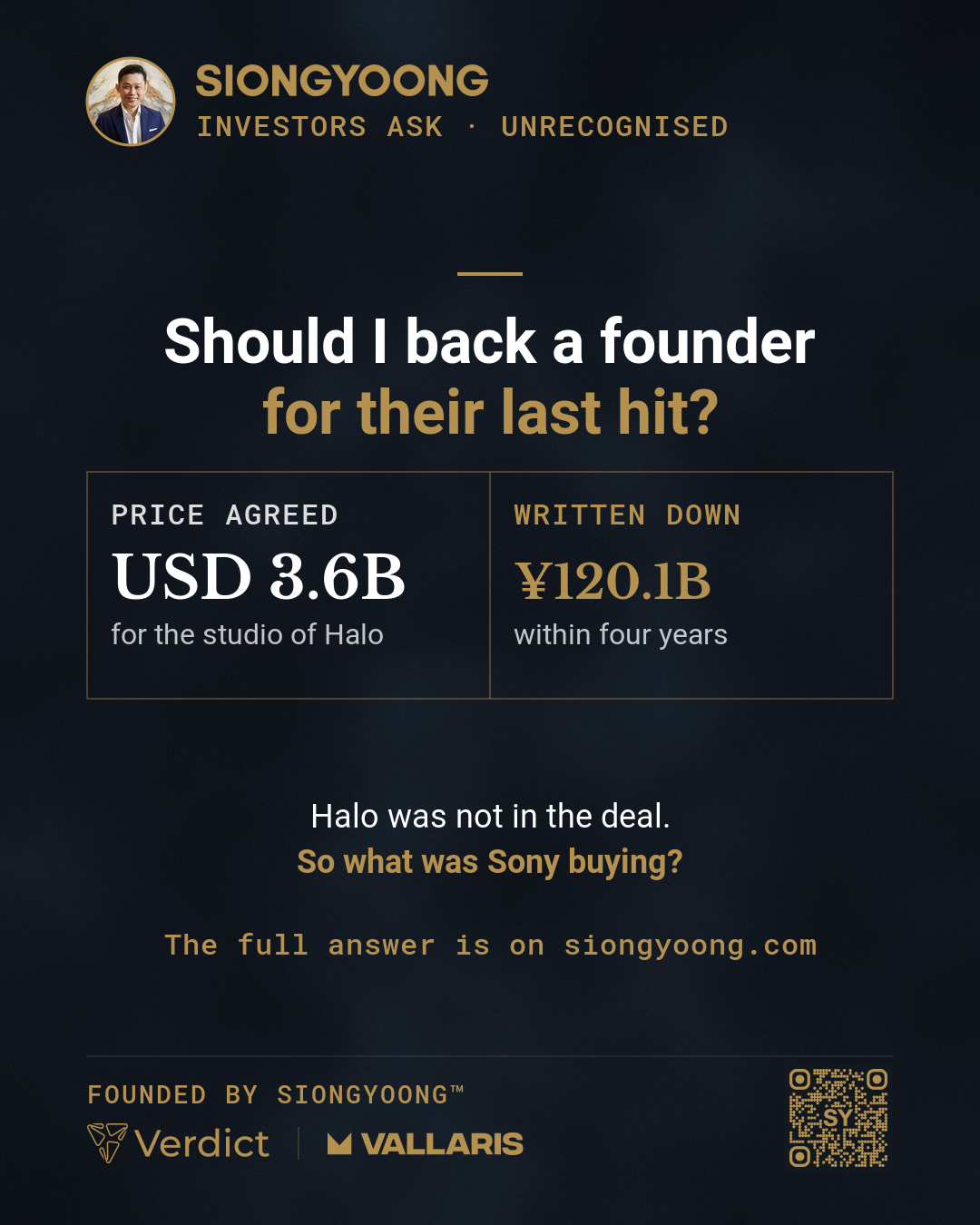
The release introduced Bungie as the studio that had created Halo. Halo was not in the deal.
What the room recognised
Each side wanted something it could not build alone. Ryan wanted Bungie’s “world-class approach to live game services,” a way “to expand the reach of PlayStation to a much wider audience.” Parsons wanted a partner that valued “the creative independence that is the heartbeat of Bungie.” Bungie would stay an independent subsidiary, run by its own board and free to publish on rival consoles (same release).
The word “created” was exact. When Bungie left Microsoft in October 2007, Microsoft’s announcement spoke of “the Microsoft-owned ‘Halo’ intellectual property” (Fortune, 5 October 2007). Sony was buying the company, its team and Destiny, the franchise that team was running. The famous name came with the people. The famous game stayed with Microsoft.
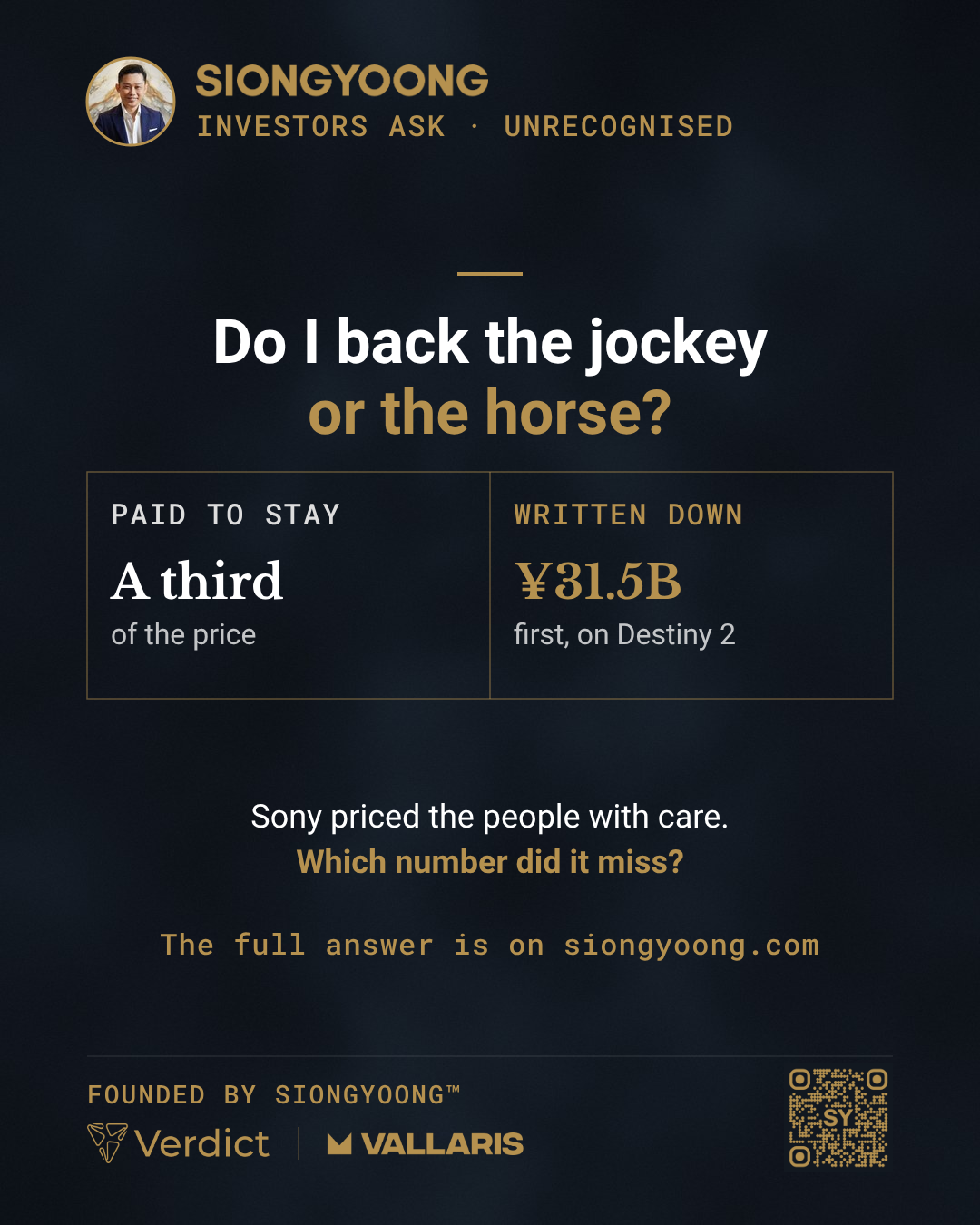
Now the number. The price was USD 3.6 billion, “inclusive of purchase price and committed employee incentives.” Video Games Chronicle reported a slide from Sony’s February 2022 earnings: about one-third of it “consists primarily of deferred payments to employee shareholders, conditional upon their continued employment” (Video Games Chronicle, 3 February 2022). Sony priced the people with care. It would pay the team over years to stay, and carry that cost through its income statement. The deal closed in July 2022 (Sony Group Form 20-F, June 2023).
Pause the story. The part of a price that buys what you cannot touch, a franchise, a technology, the earnings a product is expected to bring, sits on the buyer’s books as intangible assets. Every year the buyer asks whether those earnings will still come. When they will not, the value is cut, and the cut is called an impairment. Picture paying extra for a restaurant because the chef is famous. If the dining room empties, the extra is what the books write down first.
What the evidence showed
31 July 2024. Bungie cut 220 jobs and moved 155 more roles into Sony. Parsons wrote: “We were overly ambitious, our financial safety margins were subsequently exceeded, and we began running in the red” (Game Informer, 31 July 2024). The money for staying had kept a team together. It could not make the plan pay.
21 August 2025. Parsons stepped down after more than two decades at the studio, calling it “the honor of a lifetime.” Justin Truman, its chief development officer, took over (GeekWire, 21 August 2025).
11 November 2025. Sony recorded ¥31.5 billion of impairment against “a portion of Bungie, Inc.’s intangible and other assets in connection with Destiny 2” (Sony Group Form 6-K, 11 November 2025). Its chief financial officer, Lin Tao, said “the level of sales and user engagement have not reached the expectations we had at the time of the acquisition of Bungie,” as reported by Eurogamer (Shacknews, 11 November 2025).
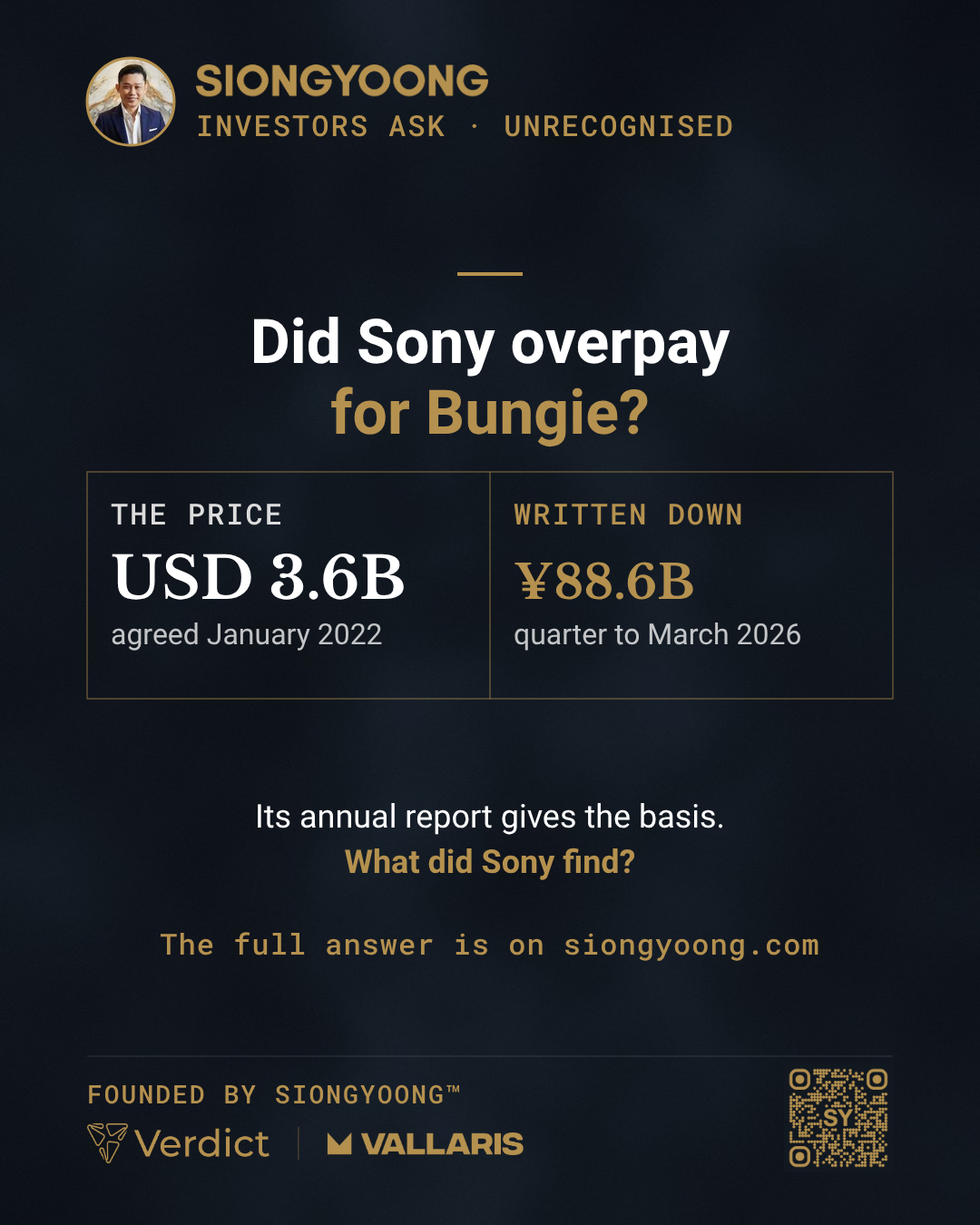
8 May 2026. A further ¥88.6 billion, making ¥120.1 billion for the year (Sony Group Form 6-K, 8 May 2026), about USD 765 million at Shacknews’s conversion (Shacknews, 7 May 2026). Its annual report gives the basis: after reviewing “the future projections for the business operated by Bungie, Inc.,” Sony found that “sufficient future cash flows were not expected to be generated to recover the carrying amount of the assets” (Sony Group Form 20-F, year to 31 March 2026).
24 June 2026. Hermen Hulst, who runs Sony’s studios, told staff that Sony was cutting “a significant number of employees, including most of the Destiny team and some Marathon team members.” Bungie’s own statement said “Destiny 2 fell short of expectations these past several years” (GeekWire, June 2026; Game Developer, 25 June 2026).
Against the roughly USD 2.4 billion of the price that was not paid for staying, close to a third was written down within four years of closing. That is my arithmetic, and it mixes 2022 dollars with a 2026 conversion, so read it as an order of size.
Sony’s side deserves its full weight. It made a third of the price conditional on the team staying, it left Bungie free to sell on every platform, and it reported each impairment in its filings as it was booked. Few buyers leave a trail this easy to follow. The team stayed long enough to be paid. The players did not stay long enough to pay.
Retention pay can keep the people. It cannot keep the players.
Recognition introduced the studio. Evidence repriced it.
What to do this week
Your version of this deal will be smaller. It is the founder whose last company you admired, or the team behind the product your sector runs on. The deck opens on that past because the past persuades. It persuaded Sony. It will persuade your investment committee, and the committee will remember the famous name long after the meeting.
Monday, open the next deck from the back. Ask for the current product’s monthly revenue and returning users for the last 12 months, and read them before the founder’s biography. If the founder’s best-known work belongs to a company they no longer run, weigh it as you would any asset outside the deal. Verdict™ reads a deck in that order: the numbers against your mandate first, the biography after.
The hit on the cover is the one asset not for sale. Find out what is for sale before your committee pays for both.
This article was written on public information available on 19 October 2026. Later events may change the picture, and this page will not be updated for them. It is general commentary for information only. It does not take into account your objectives, financial situation or needs, and it is not investment advice or a recommendation to buy, sell or hold any security. Please seek your own advice from a licensed adviser before acting. See the full disclaimer.
The questions this issue answers.
Should I back a founder for their last hit?
Where it is asked: Are serial entrepreneurs more likely to succeed? (Quora); Should I invest $100K in a startup for 3% equity? (the case rested on the CEO’s past exits) (Hacker News, 20 February 2015).
A public answer: Jason Lemkin, founder of SaaStr, “Why It’s Easier for Second-Time Founders to Raise Venture Capital” (SaaStr, 7 December 2024). A repeat founder takes the hiring, fundraising and selling risk off the table. The product risk stays. Read it
What the evidence showed: The famous thing a team made is rarely the thing you are buying.
Do I back the jockey or the horse?
Where it is asked: Why is every successful tech founder an Ivy League graduate? (Hacker News, 28 June 2025); How much do venture capitalists care about a founder’s pedigree? (Quora).
The answer that went viral: Chris Dixon, investor, later a partner at Andreessen Horowitz, “Dropbox and why you should invest in people” (his blog, shared on Hacker News, 22 March 2011; 214 points and 74 comments on Hacker News). A read of the market would have passed on another file-sync company, so back exceptional teams. Read it
What the evidence showed: Retention pay can keep the people. It cannot keep the players.
Did Sony overpay for Bungie?
Where it is asked: Did Sony overpay for Bungie? (YouTube, The Pachter Factor, 26 February 2022); Sony overpaid for Bungie, former Bungie employees say (ResetEra, 3 August 2024).
The answer that went viral: Paul Tassi, games writer, “Sony’s Bungie impairment, in summary” (X, 8 May 2026; 4,349 likes and 206 reposts). The write-down marks Bungie down to what most people already thought it was worth, and it would not happen if the games were earning. Read it
What the evidence showed: Recognition introduced the studio. Evidence repriced it.
Sources
- Sony Interactive Entertainment, “Sony Interactive Entertainment to Acquire Leading Independent Video Game Developer, Bungie”, release, 31 January 2022. Key figure: Price Sony agreed for Bungie: USD 3.6 billion.
- Sony Group Corporation, Form 20-F for the year ended 31 March 2023, filed June 2023 (Item 4.A: “In July 2022, Sony Interactive Entertainment LLC acquired Bungie”). https://www.sec.gov/Archives/edgar/data/313838/000119312523169510/d433796d20f.htm Acquisitions note (deferred payments of committed employee incentives, USD 1,179 million of USD 3,701 million): Key figure: Share of the price paid to keep the team: About one-third.
- Fortune, “Why the makers of Halo are splitting from Microsoft”, 5 October 2007, quoting Microsoft’s release.
- Video Games Chronicle, “A third of Sony’s $3.6 billion Bungie fee will be used to encourage employees to stay”, 3 February 2022, quoting a slide from Sony’s February 2022 earnings report.
- Game Informer, “Bungie Lays Off Over 200 Employees, Announces Plans For Deeper Integration With Sony”, 31 July 2024, quoting Pete Parsons.
- GeekWire, “Longtime Bungie CEO Pete Parsons steps down after more than two decades at ‘Destiny’ maker”, 21 August 2025.
- Sony Group Corporation, Form 6-K (Q2 FY2025 results presentation, slide 8), 11 November 2025. Key figure: Impairment, quarter to 30 September 2025: ¥31.5 billion.
- Shacknews, “Sony CFO Lin Tao says Destiny 2 has not reached expectations”, 11 November 2025, reporting Eurogamer’s account of the results Q&A.
- Sony Group Corporation, Form 6-K (FY2025 results presentation, slides 11 and 12), 8 May 2026. Key figures: Impairment, quarter to 31 March 2026: ¥88.6 billion; Impairment, year to 31 March 2026: ¥120.1 billion (about USD 765 million).
- Shacknews, “Sony took a $765 million impairment loss in FY25 on the $3.6 billion Bungie acquisition”, 7 May 2026 (source of the USD conversion).
- Sony Group Corporation, Form 20-F for the year ended 31 March 2026 (Item 3.D: impairment of ¥120.1 billion against Bungie’s intangible and other assets).
- GeekWire, “Sony cuts significant number of jobs at Bungie following end of ‘Destiny 2’ development”, June 2026, quoting Hermen Hulst’s email and Bungie’s statement.
- Game Developer, “Sony is laying off most of the Destiny team and some Marathon devs”, 25 June 2026.
Drawn from the public filings and reports below. A reading of one deal, not advice on any company or its shares.